DOWNED OFFICER RESPONSE & MEDICAL MANAGEMENT - Intrepid Defense Range Complex
Downed Officer Response & Medical Management (LEO)
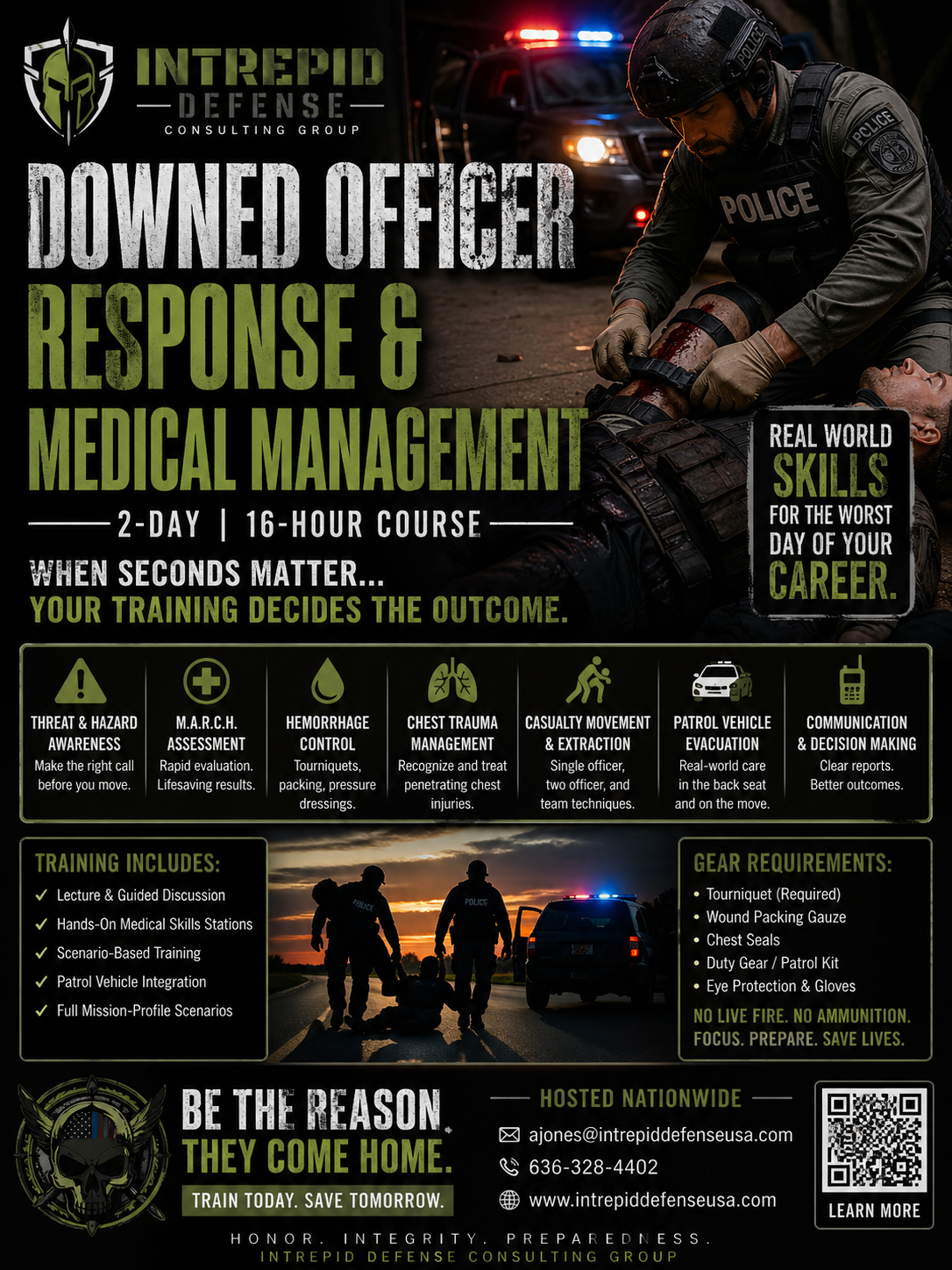
2-Day | 16-Hour Course
Course Overview
This 16-hour course prepares law enforcement officers to respond effectively to a downed officer during the critical minutes before EMS arrival. Students are trained to rapidly assess threats, identify life-threatening injuries, and execute lifesaving interventions while managing scene hazards and coordinating evacuation.
The course goes beyond traditional “gunshot-only” thinking and addresses the full spectrum of real-world causes—including environmental exposure, vehicle incidents, hazardous materials, and medical emergencies. Officers learn how to balance tactical decision-making with medical intervention, ensuring they do not create additional casualties while attempting rescue.
Core instruction focuses on:
- Rapid approach and hazard assessment
- Lifesaving medical care using the M.A.R.C.H. framework
- Casualty movement and extraction under stress
- Patrol vehicle evacuation and transport decisions
- Communication and coordination with responding assets
Training is delivered through a blend of lecture, hands-on skill stations, and scenario-based exercises, culminating in full mission-profile scenarios.
Course Breakdown
Day 1 — Approach, Threats & Lifesaving Care
Focus: Decision-making + Immediate Medical Intervention
- Downed officer problem (beyond ballistic injuries)
- Threat vs. hazard recognition (traffic, fire, HazMat, environment, etc.)
- Tactical approach framework:
- Threat
- Hazard
- Access
- Cover
- Resources
- Patient priority
- Evacuation route
- M.A.R.C.H. assessment:
- Massive hemorrhage
- Airway
- Respirations
- Circulation
- Hypothermia / Head injury
- Hemorrhage control:
- Tourniquets
- Wound packing
- Pressure dressings
- Chest trauma recognition & treatment
- Airway positioning & patient management
- Shock recognition & hypothermia prevention
?? Ends with integration scenario + debrief
Day 2 — Movement, Evacuation & Transport
Focus: Getting the officer out and keeping them alive
- Casualty movement techniques:
- Single officer
- Two officer
- Team-based extraction
- Evacuation decision-making:
- Stay and treat
- Move to CCP
- Rendezvous with EMS
- Immediate transport
- Patrol vehicle casualty care:
- Rear seat treatment
- Driver priorities
- Communication under movement
- Controlled vehicle evacuation drills
- Role-based scenarios:
- Driver
- Medic
- Communicator
- Scene security
?? Ends with full-scale culminating scenarios
- Threat + hazard + medical + evacuation combined
- Completion-based evaluation
Required Gear (Student Equipment)
Mandatory
- Tourniquet (CAT or equivalent)
- Wound packing gauze
- Chest seals (pair recommended)
Strongly Recommended
- Individual First Aid Kit (IFAK)
- Nitrile gloves
- Eye protection
- Duty belt / full kit setup (for realism)
- Radio (training or duty if applicable)
- Weather-appropriate clothing
Optional (Agency Dependent)
- Pressure dressings
- Hypothermia prevention gear (space blanket, etc.)
- Medical shears
- Marker for TQ time
Training Environment & Equipment
Students will train with:
- Patrol vehicles (static + controlled movement)
- Casualty mannequins & role players
- Medical training aids (bleeding simulators, chest seal trainers)
- Scenario props (traffic hazards, HazMat indicators, etc.)
Who This Course Is For
- Patrol officers
- SWAT / Tactical teams
- Fugitive / apprehension units
- School resource officers
- Supervisors and team leaders
Key Training Outcomes
By the end of the course, students will be able to:
- Make sound approach decisions under pressure
- Identify and treat preventable causes of death
- Apply tourniquets, wound packing, and chest seals correctly
- Move and extract casualties safely
- Execute patrol vehicle evacuations
- Make real-world transport decisions
- Deliver clear, concise radio communication during crisis
Training Philosophy
This course is built around one core principle:
“Don’t create another casualty while trying to save one.”
Students are trained to slow down their decision-making process just enough to:
- Identify threats
- Control risk
- Then move aggressively when it matters
Availability: Seats available

CONTACT US